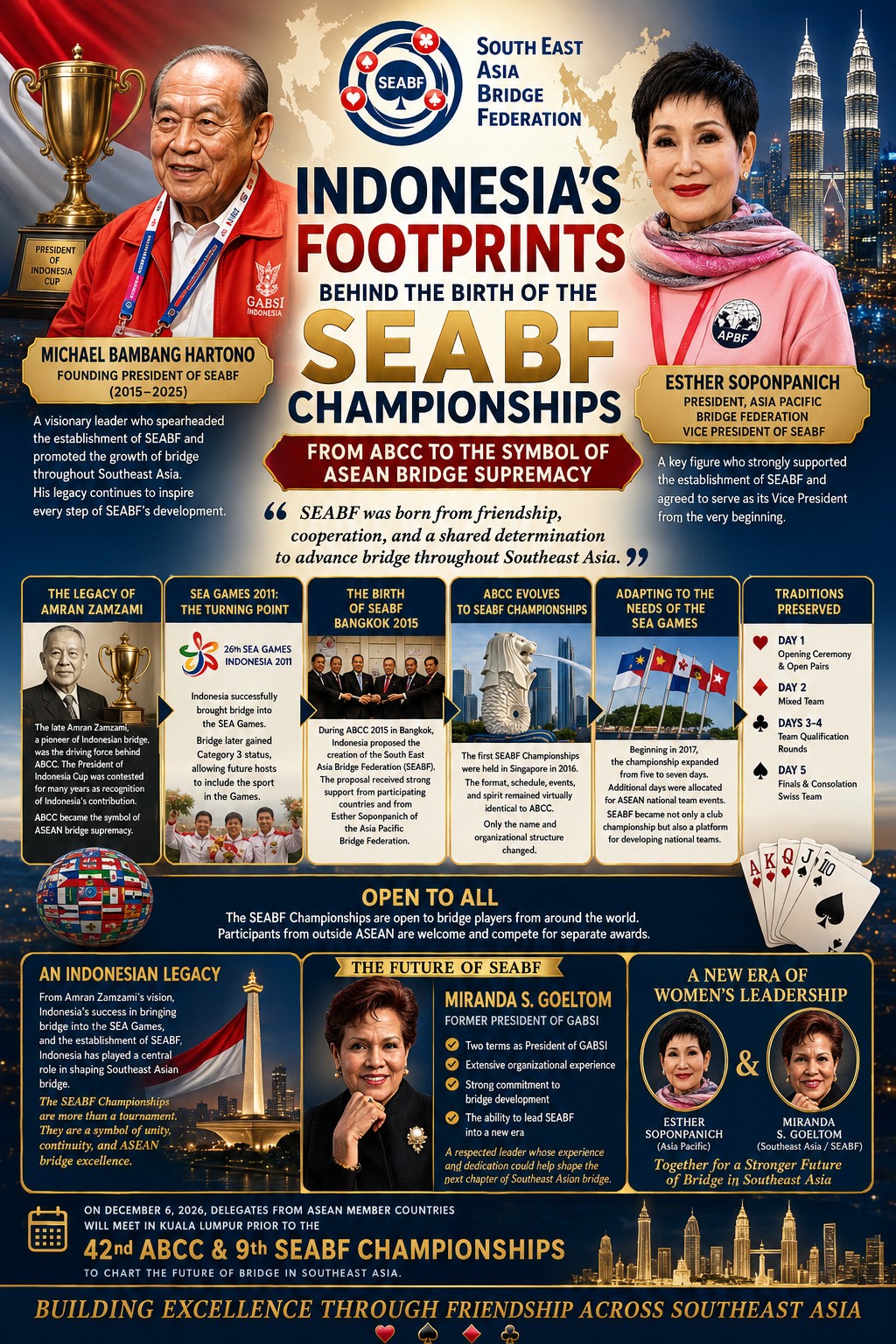
Esther Sophonpanich: The Friendly Face Behind the Rise of Bridge in Asia Pacific
By Bert Toar Polii
I first met Khunying Chodchoy (Esther) Sophonpanich at the Far East Bridge Federation Championship held in Jakarta in 1989. At that time, the organization now known as the Asia Pacific Bridge Federation (APBF) was still called the Far East Bridge Federation (FEBF).
Little did I imagine then that this gracious lady from Thailand would become one of the most influential figures in the history of bridge in Asia.
Since that first meeting, the bridge world has given us many opportunities to meet again. We crossed paths at ASEAN Bridge Club Championships, APBF Championships, and World Bridge Championships. In recent years, we have even competed in the same category—the Seniors division.
These encounters allowed me to know Esther not only as a sports administrator but also as a warm and genuine friend.
Despite leading the largest bridge organization in the Asia-Pacific region since 1989, Esther has never created distance between herself and players or national administrators. At every international championship, she is known for her characteristic smile and welcoming personality. Her friendliness makes everyone feel comfortable talking with her.
I have also met her frequently at Delegate Meetings, both of the South East Asia Bridge Federation (SEABF) and the Asia Pacific Bridge Federation (APBF). It was in these meetings that I witnessed one of her greatest strengths as a leader.
Esther has always been able to create an atmosphere that is both warm and productive. She listens patiently to the views of member countries with different backgrounds, cultures, and interests. In my opinion, this ability to build friendships and consensus is one of the main reasons she has continued to enjoy the confidence of the bridge community for more than three decades.
In the world of international sports administration, earning trust for one or two terms is already a significant achievement. Esther Sophonpanich, however, has retained the support of APBF member nations continuously since 1989. This is a testament to the respect she commands throughout the Asia-Pacific bridge community.
Under her leadership, APBF has grown into one of the strongest zones within the World Bridge Federation. The emergence of China as a world powerhouse, along with the continued strength of Japan, Indonesia, Chinese Taipei, Australia, Thailand, and others, has been part of the remarkable journey during her presidency.
She has also been deeply committed to youth development. Through APBF's junior programs and championships, a new generation of talented bridge players has emerged and successfully competed on the world stage.
Her contribution extends beyond organizational development. Esther has been among the leaders who worked tirelessly to secure broader recognition for bridge as a mind sport. One of the most significant milestones was the inclusion of bridge in the 2018 Asian Games in Jakarta and Palembang.
For Indonesia, this moment was particularly meaningful. As host nation, Indonesia had the opportunity to showcase its strength and reinforce its reputation as one of Asia's leading bridge countries.
The long-standing and harmonious relationship between APBF and the Indonesian Contract Bridge Association (GABSI) has also opened many opportunities for Indonesia to host major international events, providing valuable experience for local players and officials while introducing Indonesia to the global bridge community.
The international bridge world recognized Esther's abilities when she was elected to the Executive Council of the World Bridge Federation (WBF). This position reflects the respect she has earned through decades of dedication to the development of bridge, both in Asia and around the world.
Yet perhaps her greatest legacy is not a title or an award. Her greatest legacy is the transformation of Asia Pacific into one of the most respected regions in world bridge.
When she began leading APBF in 1989, the bridge world was still largely dominated by Europe and North America. Today, Asian countries such as China, Japan, Indonesia, Chinese Taipei, Thailand, and others are consistent contenders in major world championships.
Such a transformation does not happen overnight. It requires vision, patience, diplomacy, and a long-term commitment rarely found in sports administration.
Therefore, when the history of bridge in Asia Pacific is written, Esther Sophonpanich will be remembered not only as APBF's longest-serving president, but also as the architect who laid the foundations for Asia's rise on the world bridge stage.